Carbon Fiber: The Complete B2B Guide for Procurement & Applications (2026-2033)
📌 Executive Summary: Core Insights at a Glance
Carbon fiber is a high-performance reinforcing material composed of 5-7μm diameter filaments with 95%+ carbon content, delivering tensile strength of 4,900-5,490 MPa and modulus of 230-240 GPa—5x lighter than steel with 10x the strength. It is manufactured through PAN precursor oxidation, carbonization at 1,000-1,500°C, and available in yarn, fabric, prepreg, tube, and sheet forms. Primary applications span aerospace structures (Boeing 787, Airbus A350), automotive lightweighting (EV battery enclosures, drive shafts), industrial pressure vessels (Type IV hydrogen tanks), wind turbine blades, and high-performance sporting goods. For B2B procurement: standard MOQ is 100kg (fabric) or 100m² (tubes), pricing ranges $15-45/kg depending on form and grade, lead time is 7-10 days for standard products, and Impact Material supplies ISO 9001 certified carbon fiber products with full MTC documentation, ASTM/ISO compliance, and volume discounts up to 25%.
Technical Excellence
Tensile strength ≥4,900 MPa, modulus ≥230 GPa, density 1.78 g/cm³, 95%+ carbon content
Commercial Terms
MOQ 100kg/100m², $15-45/kg, 7-10 days lead time, 25% volume discounts
Key Applications
Aerospace (35%), automotive EV (25%), industrial (20%), sporting goods (15%), others (5%)
Quality Assurance
ISO 9001 certified, ASTM D3039/ISO 5079 compliant, MTC with every batch from Impact Material
1. What is Carbon Fiber? Definition & Fundamentals
1.1 Technical Definition
Carbon fiber is an advanced reinforcing material composed of extremely fine filaments (5-7 micrometers in diameter) with at least 95% carbon content. Each filament consists of graphitic carbon layers oriented parallel to the fiber axis, delivering exceptional tensile strength (4,900-5,490 MPa) and stiffness (230-240 GPa) while maintaining ultra-low density (1.78 g/cm³)—approximately 5x lighter than steel with 10x the tensile strength. Carbon fiber is rarely used alone; it is combined with resin matrices (epoxy, polyester, vinyl ester) to form carbon fiber reinforced polymer (CFRP) composites for structural applications.
1.2 Microscopic Structure
| Structural Level | Dimension | Characteristics | Impact on Properties |
|---|---|---|---|
| Single Filament | 5-7 μm diameter | Turbostratic carbon with graphene layers oriented parallel to fiber axis | High tensile strength along fiber axis, anisotropic properties |
| Filament Surface | Nanoscale roughness (10-50 nm) | Longitudinal grooves and ridges after surface treatment | Enhanced resin adhesion, improved interfacial shear strength (IFSS) |
| Fiber Tow | 1K-50K+ filaments per bundle | Multiple filaments bundled with controlled twist (5-40 twists/m) | Determines processability, mechanical properties, and cost |
| Sizing Layer | 0.5-2.5% by weight | Polymer coating (epoxy/polyester/vinyl ester compatible) | Protects filaments during handling, improves resin impregnation |
1.3 Historical Development
Carbon fiber development spans over 60 years of continuous innovation:
- 1950s: First commercial carbon fibers produced from rayon precursor (Union Carbide)
- 1960s: PAN (polyacrylonitrile) precursor developed, significantly improving mechanical properties
- 1970s: Aerospace adoption begins (military aircraft, space applications)
- 1980s: Commercial aviation adoption (Boeing 727, Airbus A310 secondary structures)
- 1990s: Automotive and sporting goods applications expand
- 2000s: Boeing 787 Dreamliner (50% composite by weight), Airbus A350 XWB (53% composite)
- 2010s: Automotive mainstream adoption (BMW i3, supercars), wind energy growth
- 2020s: EV battery enclosures, hydrogen pressure vessels, industrial scale-up
1.4 Carbon Fiber vs. Alternative Materials
| Material | Tensile Strength (MPa) | Density (g/cm³) | Specific Strength | Cost Index | Best For |
|---|---|---|---|---|---|
| Carbon Fiber Composite | 4,900 | 1.78 | 2,753 (100%) | 10x (baseline) | Weight-critical, high-performance structures |
| Aluminum 6061-T6 | 310 | 2.70 | 115 (4%) | 1x | General structural, cost-sensitive applications |
| Steel (Q235) | 370 | 7.85 | 47 (2%) | 0.3x | High-strength, low-cost, non-weight-critical |
| S-Glass Fiber | 4,580 | 2.49 | 1,839 (67%) | 2x | Marine, corrosion-resistant, moderate performance |
| Aramid (Kevlar 49) | 3,000 | 1.44 | 2,083 (76%) | 3x | Ballistic protection, impact resistance |
1.5 Featured Products from Impact Material
Impact Material supplies a thorough range of carbon fiber products for B2B applications. All products are manufactured under ISO 9001 certified quality systems with full traceability.
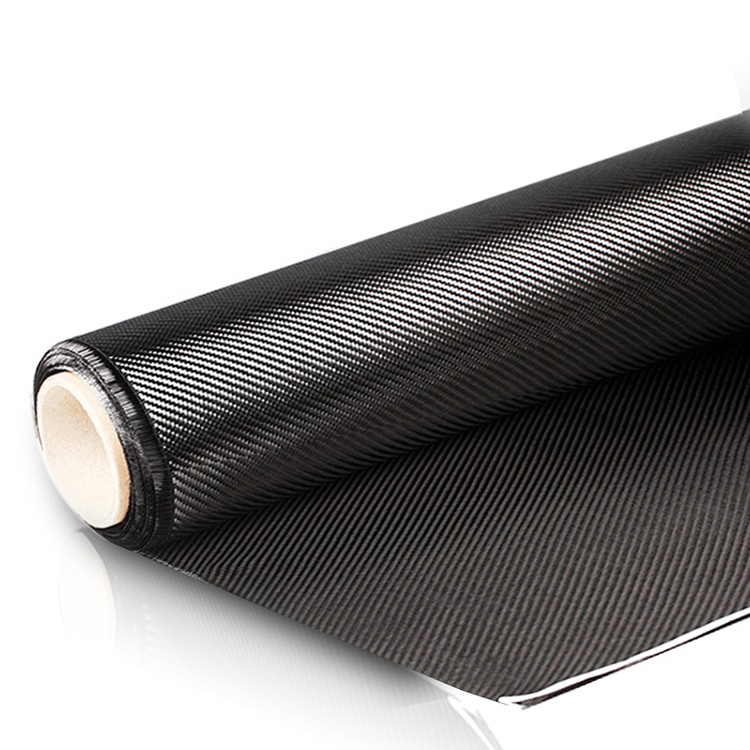
Carbon Fiber Fabric Fabric
Category: Carbon Fiber > Carbon Fiber Fabric
3K twill weave carbon fiber fabric with excellent drapability for hand lay-up, vacuum infusion, and prepregging. Ideal for aerospace panels, automotive body parts, and marine hulls.
- Filament Count: 3K
- Weave Pattern: 2×2 Twill
- Weight: 200-300 gsm
- Width: 100cm / 127cm
- MOQ: 100m²
- Lead Time: 7-10 days
- Price: $15-25/m²
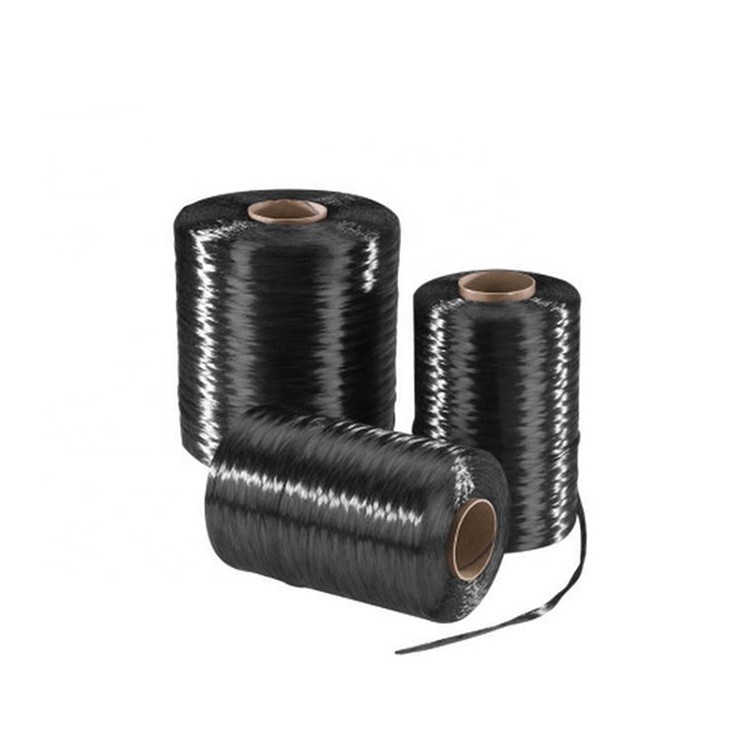
Carbon Fiber Yarn
Category: Carbon Fiber
High-performance continuous filament yarn for braiding, filament winding, pultrusion, and weaving. Available in 24K and 48K filament counts with epoxy-compatible sizing.
- Filament Count: 24K / 48K
- Tensile Strength: ≥4,900 MPa (24K)
- Modulus: ≥230 GPa
- Sizing: Epoxy-compatible (0.5-2.0%)
- MOQ: 100kg
- Lead Time: 7-10 days
- Price: $25-45/kg
2. Types & Technical Specifications
2.1 Classification by Filament Count (K Number)
| Filament Count | Designation | Tensile Strength | Typical Applications | Cost Index |
|---|---|---|---|---|
| 1K (1,000) | Ultra-fine | ≥5,000 MPa | Precision aerospace, medical devices, high-end sporting goods | 3.0x |
| 3K (3,000) | Fine | ≥4,900 MPa | Automotive trim, consumer products, marine, sporting goods | 2.0x |
| 6K (6,000) | Medium | ≥4,800 MPa | General industrial, automotive components | 1.5x |
| 12K (12,000) | Standard | ≥4,700 MPa | Wind turbine blades, industrial profiles | 1.2x |
| 24K (24,000) | Large Tow | ≥4,900 MPa | Aerospace, automotive, pressure vessels, sporting goods | 1.0x (baseline) |
| 48K (48,000) | Industrial | ≥4,500 MPa | High-volume industrial, pultrusion, filament winding | 0.8x |
| 50K+ | Extra Large | ≥4,200 MPa | Wind blades, infrastructure, automotive structural | 0.7x |
2.2 Classification by Product Form
| Product Form | Description | Primary Processes | Key Advantages | Typical Applications |
|---|---|---|---|---|
| Carbon Fiber Yarn | Continuous linear tows (24K-48K) | Braiding, winding, pultrusion | High strength utilization, cost-effective | Pressure vessels, tubes, drive shafts |
| Carbon Fiber Fabric | Woven 2D plane (plain/twill/satin) | Hand lay-up, vacuum infusion | Excellent drapability, balanced properties | Aerospace panels, automotive body, marine |
| Carbon Fiber Prepreg | Pre-impregnated with B-stage resin | Autoclave, compression molding | Consistent resin content, high performance | Aerospace structures, F1 racing |
| Carbon Fiber Tube | Pultruded or wound tubes | Direct use, machining | Ready-to-use, high stiffness | Rollers, shafts, structural supports |
| Carbon Fiber Sheet/Plate | Solid sheets (0.5-50mm thickness) | CNC machining, bonding | Isotropic properties, easy fabrication | Structural plates, brackets, inserts |
2.3 Complete Technical Specifications
| Parameter | Standard Modulus | Intermediate Modulus | High Modulus | Test Standard |
|---|---|---|---|---|
| Tensile Strength | 4,500-5,490 MPa | 5,500-7,000 MPa | 3,000-4,000 MPa | ISO 5079 |
| Tensile Modulus | 220-240 GPa | 270-320 GPa | 350-600 GPa | ISO 5079 |
| Elongation at Break | 1.8-2.3% | 1.8-2.2% | 0.8-1.2% | ISO 5079 |
| Density | 1.76-1.80 g/cm³ | 1.78-1.82 g/cm³ | 1.85-2.00 g/cm³ | ISO 1183 |
| Carbon Content | ≥95% | ≥95% | ≥99% | ASTM D3171 |
| Thermal Expansion (axial) | -0.5 to +1 ppm/°C | -0.5 to +0.5 ppm/°C | -1.0 to -0.5 ppm/°C | ASTM E831 |
